How to start a porta potty business (2026): the complete playbook
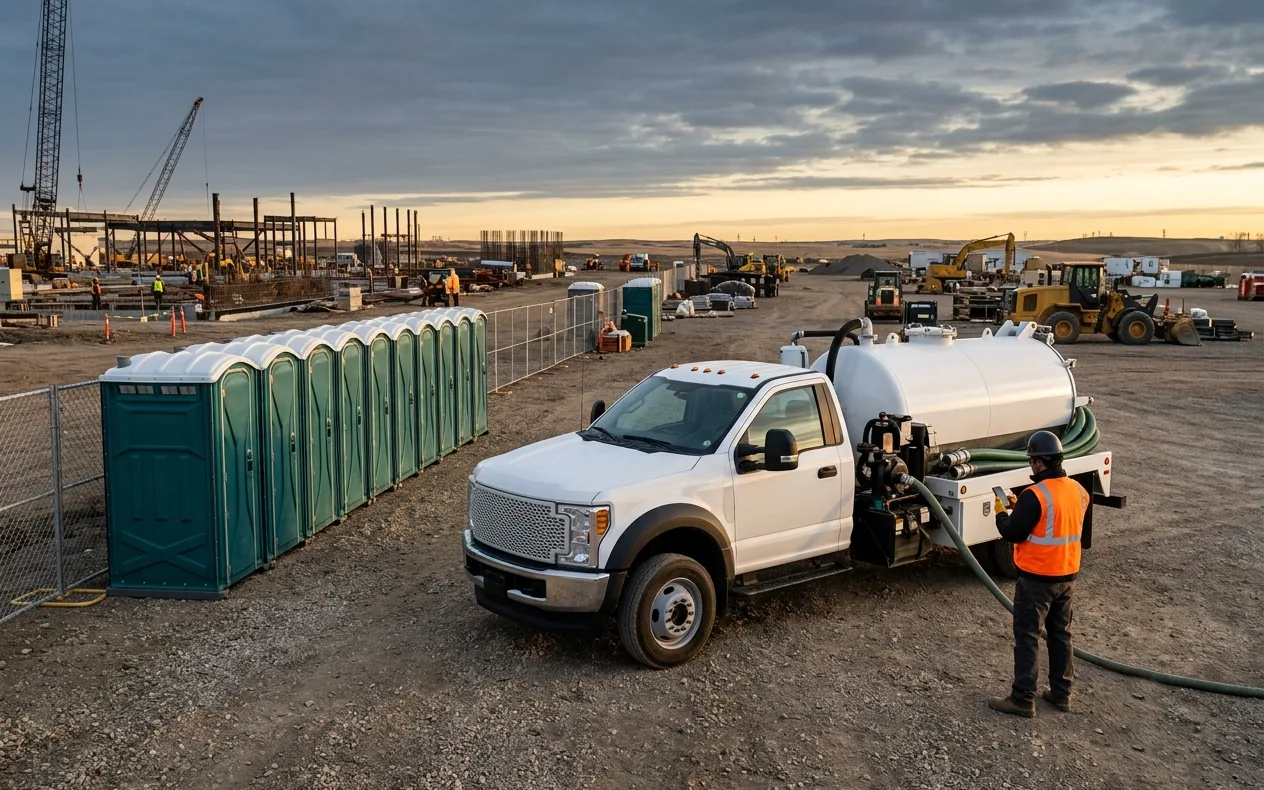
A portable restroom business is one of the least glamorous, most durable small businesses you can build. Nobody grows up wanting to pump toilets — which is exactly why the margins hold. The work keeps people out, the customers need you on a schedule, and once a unit is placed on a jobsite it bills every month until the job ends. Get the route right and it becomes one of the most predictable cash machines in local services.
This is the whole path, in the order you will actually hit it: what it costs, whether the money is real, what to buy, the truck that makes or breaks your budget, how servicing turns one placement into a recurring bill, who your two customers are, how to price, the permits and waste-disposal rules that trip people up, insurance, your first accounts, winter, and how to scale. No “passive income” fantasy — just the playbook a working operator wishes someone had handed them, with two calculators and a route service-day checklist you can use whether or not you ever sign up for anything.
What you are actually signing up for
Before the spreadsheets, be honest about the shape of the work. This is a waste-handling business first and a rental business second. Every unit you place, you are legally responsible for pumping out, hauling, and disposing of at an approved site on a schedule. That is the real product: not the plastic box, but the reliable weekly service that keeps it usable.
That reality is also the moat. The service requirement scares off casual entrants, the equipment is a real capital barrier, and the recurring nature of the work means a well-run route pays you month after month with very little churn. Construction sites do not shop around every week; they keep the operator who shows up.
The barrier to entry is real money — this is not a garage side hustle you start for a few hundred dollars. But the demand is steady, local, and fragmented: US portable toilet rental was about a $3.3 billion market in 2025, growing at roughly 5% a year, with no single company holding more than 5% share (per IBISWorld 2025 and jim.com 2026). A disciplined local operator has room to take share for years.
Is a porta potty business profitable?
Yes, for operators who build density. Net margins commonly land around 20–25% at the conservative end and 30–50% for well-run, route-dense operations (per Curbwaste and multiple 2026 industry summaries). A small fleet of 10–20 units can generate roughly $150,000–$300,000 in annual revenue and $30,000–$75,000 in net profit (per bplanmaker 2026).
But profit lives in route density — how tightly your servicing stops cluster — not in the sticker price you charge. A truck that services 30 units in a 10-mile radius earns far more per hour than the same truck chasing 30 units spread across a county. Everything in this playbook — what to buy, how to route, how to price, which accounts to chase — is really about keeping your stops close and your truck full. Two chapters go deep on the numbers: what it costs to start, with a cash-to-launch calculator, and pricing your rentals and service, with a route profitability calculator.
Step 1 — Know what it really costs
You can start leaner than most guides tell you, but not cheap. A startup guide puts a full launch at about $60,000 to $120,000 or more, with a lean start (10–15 used units plus used pumping equipment) around $50,000–$75,000 and a fuller build closer to $100,000–$150,000 (per jim.com 2026).
The single biggest line is the service truck — a new portable-restroom vacuum truck runs roughly $65,000–$150,000 (per KeeVac 2025) — which is why most people start used or with a slide-in vacuum unit. The units themselves are cheap by comparison: standard restrooms run about $900–$1,250 each (per Total Restroom 2026). The full line-by-line breakdown, two budgets, and a calculator that adds up your exact plan are in what it costs to start.
Step 2 — Buy the right units, in the right order
Buy a versatile standard lineup first and add specialty units as contracts require them. The three you will buy first are the standard unit (the workhorse), the ADA wheelchair-accessible unit (larger, required at many public events and job sites), and the standalone hand-wash station. An ADA unit costs roughly two to three times a standard one — about $2,550–$3,265 new (per Total Restroom 2026) — so buy it to meet a specific requirement, not to stock up. The full buying guide is in buying your first units.
Step 3 — Solve the truck before anything else
The vacuum truck is the heart of the business and the decision that shapes your whole budget. It is a purpose-built vehicle with split waste and fresh-water tanks and a pump — not a cargo van. Most people start used ($45,000–$80,000, per jim.com 2026) or with a slide-in vacuum unit that drops into a full-size pickup they already own (per KeeVac 2026), then upgrade once the route can carry a truck payment. How the truck works, how to size the tank, and how it sets your route capacity are all in the service truck.
Step 4 — Understand that servicing is the business
This is the part new operators underestimate. Every rented unit is serviced on a schedule, and weekly is the industry standard for a normal construction unit (per Patriot Portable Restrooms and ServiceCore 2025). Servicing means pumping the waste tank, rinsing, refilling fresh water and deodorizer, restocking paper, and disinfecting.
That recurring service is why one placement bills every month instead of once. Forty units on standing weekly service is a route that pays you every month whether or not you land a new customer that week. Build your routes so every standing unit hits its cadence, and treat a missed service as an emergency — an overflowing unit is the complaint that ends a construction account. How to build a route and prove every stop was serviced is in routes and servicing cadence.
Step 5 — Serve your two customers, and price for the route
Almost every account is either construction or events, with construction estimated at roughly 40–50% or more of total demand (per jim.com 2026 and PSAI). Construction is the recurring, contract-based backbone; events are higher-priced but one-off. Most successful operators run a mix, and the mix decides your stability — the full comparison is in construction versus events.
Whichever you serve, price up from your servicing cost, not down from a competitor. Every rate has to cover the weekly pump-out, chemicals, disposal fees, fuel, and your time — plus a margin. Because the same drive serves many stops, dense routes cost far less to service than scattered ones. The cost-up method and typical US rate ranges are in pricing your rentals and service.
Step 6 — Get the permits and disposal right
This is the part that varies most by where you operate, and the part you cannot fake. You pump each unit into your truck and dispose of the waste only at an approved site — typically a municipal wastewater treatment plant or a licensed dump station (per Porta Potty Calculator 2025). Most operators need a state liquid-waste hauler permit (roughly $200–$1,000 a year, per jim.com 2026) plus written confirmation that their receiving plant will accept their loads.
Because hauling and disposal are regulated at the state and county level, there is no single national rule — you verify the requirements for your own county before you take your first paying account. How to find and follow your local rules is in permits and waste disposal.
Step 7 — Insure the truck and the waste exposure
A portable restroom operation carries three coverages at minimum: general liability, commercial auto for the vacuum truck, and — because you are hauling waste — a pollution liability rider that general policies often exclude (per jim.com 2026). Budget roughly $2,000–$5,000 for your first year of coverage overall (per jim.com 2026). The truck is usually your largest insurance line because a heavy vehicle hauling liquid waste is a higher-risk class. The full walkthrough is in insurance for a portable restroom business.
Step 8 — Win your first 10 accounts, then hold them
Go straight to the people who need units on a schedule: local general contractors, builders, and site supervisors for construction, and event planners, venues, and municipalities for events. Your first accounts come from local relationships and being the operator who answers the phone and services on time — not from ads. Chase a few standing construction accounts first to build a dependable base, then add events as your route has capacity. How to find and keep them is in getting your first 10 accounts.
Step 9 — Survive winter, then scale the route
In cold markets, construction and outdoor events slow in deep winter, and cold-weather servicing means winterizing units against freezing. Construction contracts, which run longer and steadier than one-day events, are what carry many operators through. How to winterize and plan cash flow through the quiet months is in seasonality and winter.
When you do grow, densify the route you have before you buy a second truck. Route density is the cheapest growth there is: adding units to accounts you already service raises revenue without adding much drive time. When and how to add a second truck and driver is in scaling routes and adding a second truck.
The tool this playbook comes with
Here is where new operators quietly lose accounts: the route lives in a driver’s head and a paper log, a stop gets skipped, and nobody can prove a unit was serviced when the site manager calls. From your first account, run the route from a system that drives the day offline in a dead-zone jobsite, stamps every service with a photo and a timestamp you can forward, and bills on the 28-day cycle this trade actually runs on. The free tier tracks up to 10 units and two active placements with no card — enough to prove the loop on your first accounts — and invoices go out under your own brand on your own payment links. Work through the chapters below in order, or jump to what you need next.
The chapters, in order
Read it start to finish, or jump to what you need. Every chapter stands on its own and ends with straight answers to the questions operators actually ask.
- Chapter 1What it costs to start a porta potty businessThe real line items behind a portable restroom startup — units, the service truck, chemicals, insurance, and registration — with a lean and a fuller budget and a calculator that totals your cash-to-launch.Read it →
- Chapter 2Buying your first units: standard, ADA, and hand-wash stationsWhat to buy first and why — standard restroom units, ADA wheelchair-accessible units, and standalone hand-wash stations — with real per-unit prices and a buying order set by what your accounts actually require.Read it →
- Chapter 3The service truck: your biggest, most important decisionThe vacuum truck is the heart of a portable restroom business — how the pump and split waste and fresh-water tanks work, new vs used vs a slide-in vacuum unit, tank sizing, and how the truck sets your route capacity.Read it →
- Chapter 4Routes and servicing cadence: the recurring engineWeekly servicing is what turns one placement into a monthly bill — how to build a route, why cadence and density drive your margin, how many units a truck services a day, and the record that answers a service dispute.Read it →
- Chapter 5Construction versus events: the two customersThe two customer types behind almost every portable restroom business — long-run construction accounts and one-off events — how their contracts, cadence, and cash flow differ, and why the mix decides your stability.Read it →
- Chapter 6Pricing your rentals and service so the route paysA cost-up method for pricing portable restroom rentals and service — covering the pump-out, chemicals, disposal, and drive time — plus typical US monthly and event rate ranges, and a route profitability calculator.Read it →
- Chapter 7Permits and waste disposal, done rightWhere portable restroom waste legally goes, the hauler permits and local rules that govern it, typical disposal fees, and how to verify the requirements for your own county — because this is the part that varies most.Read it →
- Chapter 8Insurance for a portable restroom businessWhat a porta potty operation needs to carry — general liability, commercial auto for the vacuum truck, and a pollution liability rider for the waste exposure — what it typically costs, and why the truck drives the premium.Read it →
- Chapter 9Getting your first 10 accountsWhere the first portable restroom accounts actually come from — local contractors and GCs, event planners, a simple quote-and-book front door, and the reliability habits that turn one construction site into a standing route.Read it →
- Chapter 10Seasonality and winter in a portable restroom businessHow weather shapes a portable restroom route — the warm-season peak, the winter slowdown in cold climates, how to winterize units against freezing, and how construction contracts and an off-season plan carry the quiet months.Read it →
- Chapter 11Scaling routes and adding a second truckWhen and how to grow a portable restroom business past solo — densifying routes before adding trucks, timing a second truck and driver against proven demand, and systemizing servicing so growth adds profit instead of chaos.Read it →
Free toolkit
The route service-day checklist
Everything a driver runs through on a service day — from loading the truck to the last pump-out and the record that proves it — in the order it actually happens.
Unsubscribe is one click, and we never share addresses.
Something went wrong and we couldn’t send it just now. Please try again in a moment.
Before you roll
- Confirm today's stops and the order you'll drive them — tightest route, least backtracking.
- Check freshwater and deodorizer levels; top off the blue chemical and fresh-water tank.
- Confirm waste-tank capacity leaves room for the whole route before a disposal run.
- Load paper, seat covers, hand soap or sanitizer, and spare parts (springs, latches, vent screens).
- Pack gloves, a pressure washer or hose, a pump wand, and your spill kit.
At every unit
- Pump the tank fully; rinse the tank and bowl until the water runs clear.
- Refill with fresh water and the measured dose of deodorizer.
- Restock paper and seat covers; refill the hand-wash or sanitizer station.
- Wipe down surfaces, check the door latch and vent, and note any damage to repair or replace.
- Photograph the serviced unit with a timestamp — the record you can forward if anyone asks.
Disposal & close-out
- Dispose of waste only at an approved site — a wastewater treatment plant or licensed dump station.
- Log the disposal (volume, site, date) — informational, but worth keeping.
- Flag any unit that needs a return trip, a repair, or a relocation for the office.
- Confirm every stop on today's route is marked serviced before you call it a day.
A starting point to adapt to your fleet and your local disposal rules — verify waste-handling requirements with your county or state health department.
Frequently Asked Questions
- How much does it cost to start a porta potty business?
- Plan for a real capital outlay: a startup guide puts a full launch at about $60,000 to $120,000 or more, with a lean start (10–15 used units plus a used vacuum truck) around $50,000–$75,000 and a fuller build closer to $100,000–$150,000 (per jim.com 2026). The service truck is the single biggest line — a new portable-restroom vacuum truck runs roughly $65,000–$150,000 (per KeeVac 2025), which is why most people start with used equipment or a slide-in vacuum unit. The startup cash-to-launch calculator in the costs chapter adds up your exact plan.
- Is a porta potty business profitable?
- It can be, and the economics are unusually durable because the money is recurring. Net margins commonly land around 20–25% at the conservative end and 30–50% for well-run, route-dense operations (per Curbwaste and multiple 2026 industry summaries). A small fleet of 10–20 units can generate roughly $150,000–$300,000 in annual revenue and $30,000–$75,000 in net profit (per bplanmaker 2026). Profit lives in route density — how tightly your servicing stops cluster — not in the sticker price you charge.
- Do porta potties have to be serviced, and how often?
- Yes — every rented unit is serviced on a schedule, and weekly is the industry standard for a normal construction unit (per Patriot Portable Restrooms and ServiceCore 2025). Servicing means pumping the waste tank, rinsing, refilling fresh water and deodorizer, restocking paper, and disinfecting. High-traffic or large-crew sites go to two or three times a week. That recurring service is the whole business model — it is why one placement bills every month instead of once.
- What do you do with the waste?
- You pump each unit into your truck and dispose of it only at an approved site — typically a municipal wastewater treatment plant or a licensed dump station that accepts hauled portable-restroom waste (per Porta Potty Calculator 2025). Waste hauling and disposal are regulated at the state and county level, and most operators need a state liquid-waste hauler permit (roughly $200–$1,000 a year, per jim.com 2026) plus written confirmation their local plant will accept their loads. Rules vary widely — verify with your county or state health department and your receiving plant before you haul a single load.
- How many units do I need to start?
- Enough to justify the truck and route. Operators commonly start with 10–20 units, since a single technician can manage 100–120 units on the books once routes are dense (per jim.com 2026). You can start smaller with a slide-in vacuum unit and a handful of units to prove your first accounts, then reinvest rental income into more units and a dedicated truck. Let your booked recurring accounts, not ambition, set the pace of buying.
- Is this a seasonal business?
- It depends on your climate. In warm regions it runs year-round; in northern markets, construction and outdoor events slow in deep winter, and cold-weather servicing means winterizing units with antifreeze chemistry (magnesium chloride at about 2 lb per gallon protects to roughly −20°F, per Prime Dumpster and Satellite Industries 2025). Many operators add a small winterization fee per cycle and lean on construction contracts, which run longer and steadier than one-day events, to carry the slower months.
When you're ready to run the route from your phone
SwapProof is built for solo and small-crew portable-restroom operators — track your fleet, drive the route offline in a dead-zone site, and stamp every service with a photo, GPS when you allow it, and a timestamp you can forward. The free tier tracks up to 10 units and two active placements — enough to prove the loop on your first accounts, no card — and invoices go out under your brand, on your own payment links.
Start free