Construction versus events: the two customers
Almost every dollar in this business comes from one of two customers, and they could not be more different. One is a steady, unglamorous, recurring account that anchors your route. The other is a higher-priced, one-off job with more moving parts. Understanding how each behaves — and what mix of the two you want — is how you build a business that is both stable and profitable instead of one or the other.
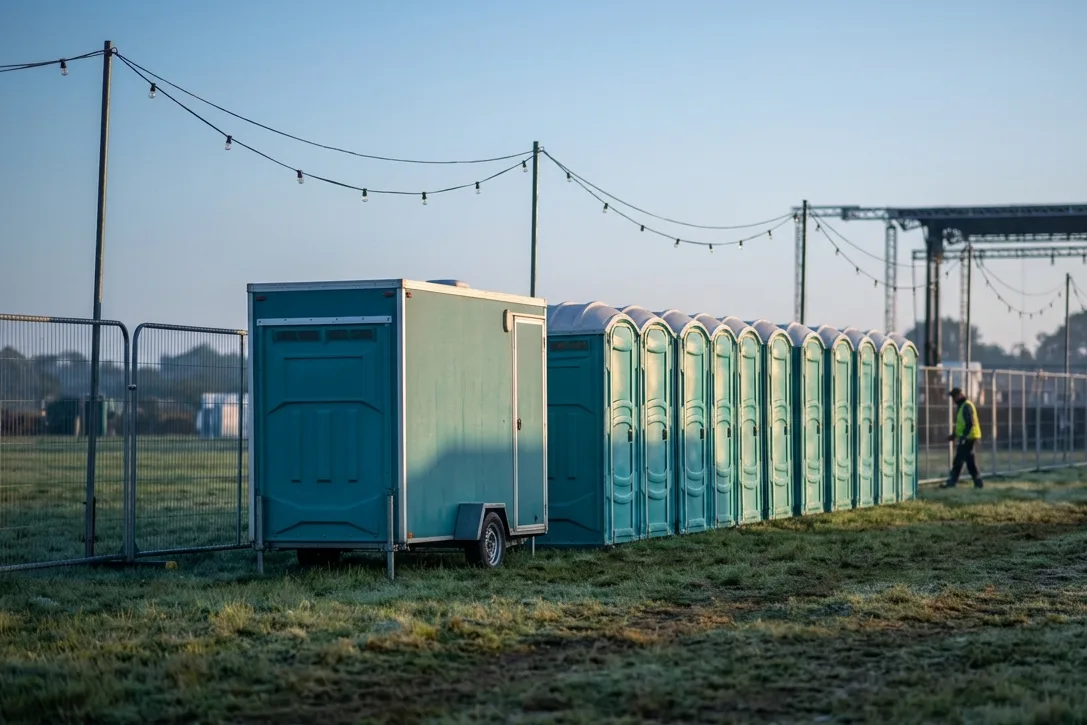
Who rents porta potties
Mostly construction sites and events, with construction estimated at roughly 40–50% or more of total demand and events making up much of the rest, alongside disaster relief and recreation (per jim.com 2026 and PSAI). Construction is the recurring, contract-based backbone; events are higher-priced but one-off. Most successful operators run a mix of both, and the balance you strike decides your stability.
The construction account
A construction account is a standing placement: you drop a unit (or several) on a jobsite, put it on weekly service, and bill monthly for as long as the job runs — often many months. It is steady, predictable, and route-friendly, because the unit stays put and you service it on a fixed cadence.
Construction units bill about $125–$225 a month on recurring service (per jim.com 2026 and Potty Directory 2025). That is a lower per-unit rate than an event, but it compounds: the same unit bills every month, the site does not shop around, and a good relationship with a general contractor turns into their next three jobsites. Construction is where the recurring revenue lives, and recurring revenue is what makes this business worth building.
The downside is that construction is price-sensitive and reliability-obsessed. GCs remember the operator whose unit overflowed, and they remember the one who never missed a service. You win construction on dependability, not on a clever pitch — which is why routes and servicing cadence matters so much to this side of the business.
The event customer
An event is a short rental — a day or a weekend — at a premium price, delivered and picked up around the event. Weddings, festivals, fairs, races, block parties, and municipal events all need units, sometimes a lot of them, for a short window.
Event rentals can command $150–$300 per unit for a weekend (per jim.com 2026) — a higher rate than construction, because the customer needs them now and for a specific occasion. But they come and go: there is no recurring bill, more scheduling churn, tighter delivery windows, and often an accessibility requirement (ADA units at a set ratio) written into the venue’s or the municipality’s rules.
Events add margin on top of a stable route, and they let you charge a premium your construction accounts never would. But a business built only on events is a business that starts from zero every month.
Which is more profitable?
They earn differently, and the honest answer is that you want both. Construction builds the durable base — a predictable monthly floor that covers your fixed costs and keeps your truck busy. Events add higher-margin work on top when your route has the capacity to serve them.
The practical sequence for a new operator is construction first, events second. Land a few standing construction accounts to build a dependable base and prove your route, then take events as capacity allows. That order gives you cash-flow stability before you chase the higher-priced but lumpier event work. The chapter on getting your first 10 accounts walks through where each type of customer actually comes from.
What a rental contract should cover
Whether it is a construction placement or an event, the paperwork protects you when something goes wrong. A rental contract should name:
- The parties, and the units and quantities.
- The delivery and pickup dates, the service cadence, and the address and placement.
- The price and billing terms.
- Damage, relocation, and overflow responsibility, and extra-service and cancellation policy.
Construction contracts also spell out the monthly service schedule; event quotes spell out delivery, pickup, and any same-event servicing. Clear terms up front prevent the dispute later — the driveway argument you avoid by writing it down first.
The event-quote checklist below is a free, build-your-own starting point for the event side specifically: everything to nail down before you quote, so your price covers the whole job and nothing gets forgotten on the day. Adapt it to your fleet, and confirm any accessibility and permit requirements for the venue before you send a number.
Free toolkit
The event quote checklist
Everything to nail down before you quote an event — headcount, unit mix, delivery, and same-event servicing — so your price covers the job and nothing gets forgotten on the day.
Unsubscribe is one click, and we never share addresses.
Something went wrong and we couldn’t send it just now. Please try again in a moment.
Scope the event
- Expected attendance and event length (hours or days) — the driver of how many units.
- Whether alcohol or food is served (raises usage) and any peak windows.
- Number of standard units, ADA-accessible units, and hand-wash stations required.
- Any accessibility ratio the venue, permit, or code requires.
Delivery & placement
- Delivery date and time window, and the pickup date and time.
- The exact placement and surface, plus truck access to reach the units.
- Distance from your yard — the delivery and pickup fee by mileage.
- Whether the units must be serviced during the event (multi-day or high-traffic).
Price & terms
- Per-unit rate by type, plus delivery, pickup, and any on-site service.
- Deposit, balance due, and cancellation and weather policy.
- Damage and cleaning terms, and who is responsible if a unit is moved.
- A written quote the customer signs — so the scope and price are agreed before delivery.
A starting point to adapt — build your own quote from it and confirm any accessibility and permit requirements for the venue.
Frequently Asked Questions
- Who rents porta potties?
- Mostly construction sites and events, with construction estimated at roughly 40–50% or more of total demand and events making up much of the rest, alongside disaster relief and recreation (per jim.com 2026 and PSAI). Construction is the recurring, contract-based backbone; events are higher-priced but one-off. Most successful operators run a mix of both.
- What is the difference between construction and event customers?
- A construction account is a standing placement billed monthly with weekly service, often running for months — steady, predictable, and route-friendly. An event is a short rental (a day or a weekend) at a premium price, delivered and picked up around the event, with more scheduling churn. Construction gives you stable recurring revenue; events give you higher per-unit rates but demand more coordination.
- Which is more profitable, construction or events?
- They earn differently. Construction units bill about $125–$225 a month on recurring service (per jim.com 2026 and Potty Directory 2025) and compound into a stable route; event rentals can command $150–$300 per unit for a weekend (per jim.com 2026) but come and go. Construction builds the durable base; events add margin on top when your route has the capacity to serve them.
- What should a rental contract cover?
- The parties, the units and quantities, the delivery and pickup dates, the service cadence, the address and placement, the price and billing terms, damage and relocation responsibility, and your policy on overflow, extra services, and cancellation. Construction contracts also spell out the monthly service schedule; event quotes spell out delivery, pickup, and any same-event servicing. Clear terms up front prevent the dispute later.
Run the route from your phone, and stamp every stop
SwapProof is built for solo and small-crew portable-restroom operators — track your fleet, drive the route offline in a dead-zone site, and stamp every service with a photo, GPS when you allow it, and a timestamp you can forward. The free tier tracks up to 10 units and two active placements — enough to prove the loop on your first accounts, no card.