Routes and servicing cadence: the recurring engine
Most people think a portable restroom business rents toilets. It does not — it sells recurring service. The unit is just the thing the service attaches to. Once you see the business that way, every important decision gets clearer: why weekly cadence is the whole model, why route density is the biggest lever on your margin, and why a skipped stop is an emergency. This chapter is about the engine that makes the money recur.
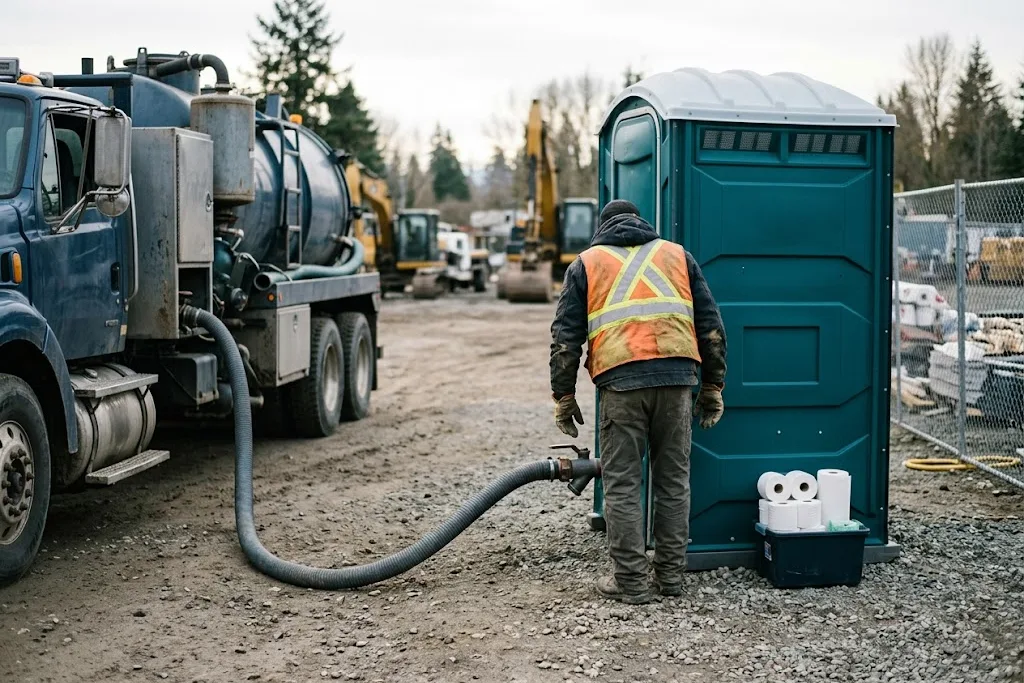
Why servicing is the business
A single unit placed on a jobsite bills every month for the service, not once for the rental. That one sentence is the entire business model.
Rent a unit for a one-day event and you earn once. Place that same unit on a construction site on standing weekly service and it bills every month for as long as the job runs — often many months. Forty units on standing service is a route that pays you every month whether or not you land a single new customer that week. That recurring service revenue, not the one-day event rentals, is the cash-flow backbone that makes this business durable.
Which means the servicing is not overhead on top of the rental. The servicing is the product you are selling. Everything else — the units, the truck, the marketing — exists to support the reliable weekly service that keeps the money coming.
What “service” actually means
Weekly is the industry standard for a normal construction unit (per Patriot Portable Restrooms and ServiceCore 2025). A single service means:
- Pump the waste tank fully into your truck.
- Rinse the tank and bowl until the water runs clear.
- Refill with fresh water and the measured dose of deodorizer.
- Restock paper and seat covers; refill the hand-wash or sanitizer.
- Disinfect and wipe down surfaces, and check the door latch and vent.
High-traffic sites or large crews move to two or three services a week; event units are serviced around the event. The service contract sets the cadence, and the cadence sets your revenue — a unit on twice-weekly service bills more than the same unit on weekly.
Building a route
A route is a sequence of stops ordered to minimize drive time. The goal is simple: service the most units in the fewest miles, because every mile between stops is time your truck is earning nothing.
- Cluster geographically. Group stops by neighborhood and drive them in a loop, not back and forth across town. A tight cluster of 20 stops beats 20 stops scattered across a county every time.
- Order for the tank. Plan the route so you offload at your disposal site when the tank is full and near the site, not when you happen to be farthest from it. A truck services 15 to 60 units before it has to offload (per Porta Potty Calculator 2025), so know where in the route that limit lands.
- Confirm access. A locked gate or a moved unit turns a two-minute stop into a fifteen-minute problem. Know before you roll.
Route density is the single biggest lever on your margin. Tightly clustered stops mean more units serviced per hour and a lower cost per unit; a scattered route burns the day in the truck. When you weigh a new account far outside your existing stops, weigh the windshield time it adds — sometimes a distant account quietly loses money even at a good rate. The pricing chapter and its route calculator show how density flows straight to your bottom line.
Never miss a service
A missed service is how you lose a construction account. An overflowing unit on a jobsite is the complaint that ends a contract and the review that costs you the next one. Contractors talk to each other, and “they let it overflow” travels fast.
So the operational discipline that matters most is knowing, every day, that every standing unit hit its cadence. Build your routes so each unit is scheduled, track which stops are done, and flag a missed or skipped stop the same day so it gets covered before it becomes a problem. What one driver tracks in their head works until it does not — usually the week you are busiest and can least afford a skipped stop.
Prove the service happened
The other half of reliability is proof. When a site manager claims a unit was skipped — and they will — the strongest answer is not an argument, it is a record: a dated, photographed service capture taken at the unit, with a timestamp and the location. Forward it and the dispute is over.
This is exactly the loop a tool built for this trade should run: the driver opens the day’s route (it has to work offline, because jobsites are dead zones), services each stop, and captures a photo, GPS when the driver allows it, and a timestamp at the unit. The record documents that you completed your own service checklist — it is not a certification of anything beyond what you did on the day — and it lands in a customer history you can forward. The free tier tracks up to 10 units and two active placements with no card, which is enough to run your first route and prove the loop. A missed-stop flag and a forwardable record are worth more to a construction account than any sales pitch, because in this business reliability, documented, is the whole product.
Frequently Asked Questions
- How often does a porta potty need to be serviced?
- Weekly is the industry standard for a normal construction unit — pump the waste, rinse, refill fresh water and deodorizer, restock paper, and disinfect (per Patriot Portable Restrooms and ServiceCore 2025). High-traffic sites or large crews move to two or three services a week, and event units are serviced around the event. The service contract sets the cadence, and the cadence sets your revenue.
- Why does weekly service matter so much to the business?
- Because it is what makes the revenue recurring. A single unit placed on a jobsite bills every month for the service, not once for the rental — so 40 units on standing weekly service is a route that pays you every month whether or not you land a new customer that week. That recurring service revenue, not the one-day event rentals, is the cash-flow backbone of the business.
- How many units can I service in a day?
- It depends on route density and tank size — a truck services 15 to 60 units before offloading (per Porta Potty Calculator 2025), and how many stops fit in a day comes down to drive time between them. Tightly clustered stops mean more units serviced per hour and a lower cost per unit; a scattered route burns the day in the truck. Route density is the single biggest lever on your margin.
- How do I prove a unit was actually serviced?
- The strongest proof is a dated, photographed service record captured at the unit — a photo, a timestamp, and the location. When a site manager claims a unit was skipped, a forwarded record with the date and photo answers it faster than any argument. A record documents that you completed your own service checklist; it is not a certification of anything beyond what you did on the day.
- What happens if I miss a scheduled service?
- A missed service is how you lose a construction account — an overflowing unit on a jobsite is the complaint that ends a contract and the review that costs you the next one. Build your routes so every standing unit hits its cadence, track which stops are done, and flag a missed or skipped stop the same day so it gets covered before it becomes a problem.
Run the route from your phone, and stamp every stop
SwapProof is built for solo and small-crew portable-restroom operators — track your fleet, drive the route offline in a dead-zone site, and stamp every service with a photo, GPS when you allow it, and a timestamp you can forward. The free tier tracks up to 10 units and two active placements — enough to prove the loop on your first accounts, no card.