Seasonality and winter in a portable restroom business
How seasonal this business is depends almost entirely on where you operate. In warm regions it runs year-round. In northern markets, construction and outdoor events slow through deep winter, demand trims, and cold-weather servicing gets more expensive and more technical. This chapter is about reading your own climate, keeping units working when it freezes, and structuring your accounts and your costs so the quiet months do not sink you.
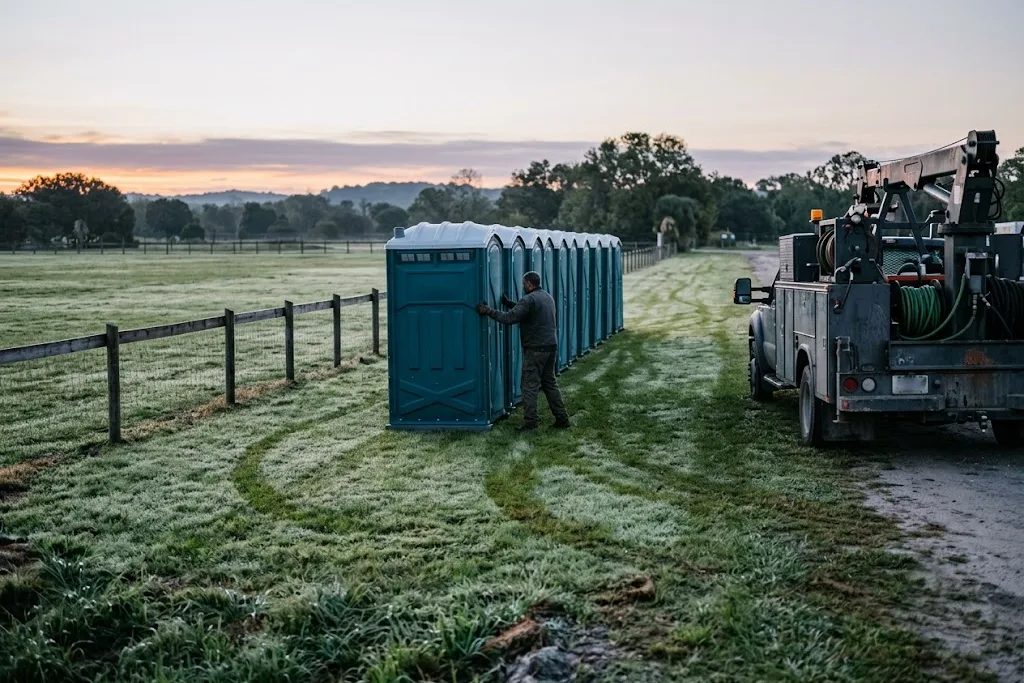
Is it a seasonal business?
It depends on your climate. In warm regions the work runs all twelve months. In cold ones, construction and outdoor events slow through deep winter, which trims demand and adds cold-weather servicing cost. The single biggest stabilizer is your customer mix: construction contracts run longer and steadier than one-day events, so an operator with a base of standing construction accounts feels winter far less than one who lives on event rentals. This is one more reason the construction versus events balance matters — construction is what carries many operators through the slow months.
Before you plan your year, be honest about which climate you are in. A Gulf Coast operator budgets for twelve roughly even months; a Midwest or Northeast operator budgets for a busy stretch that has to pay for a lean one. Get that shape right and the rest of the plan follows.
Keeping units from freezing
In cold markets, the units you keep in service through winter have to be winterized, because a frozen holding tank is a unit you cannot service. The chemistry is specific:
- Magnesium chloride at about 2 lb per gallon protects to roughly −20°F and is less corrosive than rock salt (per Prime Dumpster and Satellite Industries 2025).
- Methanol is effective to about −9°F (per Prime Dumpster and Satellite Industries 2025).
Operators also use insulation, wind-sheltered placement, and a pellet or chemical dose at each cold-weather service to keep the holding solution from freezing between visits. Follow your chemical supplier’s guidance for your actual temperatures — the right dose depends on how cold your route gets and how often you service.
Charge for the added winter cost
Cold-weather servicing costs more in chemicals and time, so many operators add a winterization fee — commonly about $10–$20 per billing cycle per unit (per Prime Dumpster 2025). Publish the fee up front so it is part of the contract, not a surprise, and make sure it actually covers the added winter cost per unit. This is a real expense you are recovering, not a markup, so tie it to the chemistry and the extra time the way the pricing chapter frames every fee.
Plan cash flow around the season you have
If your market slows in winter, the discipline is the same one every seasonal operator learns: bank against the quiet. Insurance, any truck payment, and permits keep hitting whether or not you are busy, so set aside a share of your peak-season revenue to cover fixed costs through the slow stretch. A busy summer is not profit until winter’s fixed costs are already covered.
For the units that come off jobs in winter, use the idle time well: clean and repair them, plan winterization for the units that stay out, and line up the spring construction accounts that will fill your route when the season turns. The quiet months are when you do the maintenance and the account-building you have no time for in July.
Winter armor: the off-season pause
Here is a genuine advantage this trade has over software priced for year-round businesses. Because portable sanitation is seasonal for so many operators, a tool built for it should let you stop paying a full software bill when the units come back to the yard — without losing your records or cancelling outright.
That is what an off-season pause is for. When you power down for winter, you downgrade to a low read-only rate instead of paying a full subscription or losing your account: your proof-of-service archive stays live and shareable — a January dispute about a September invoice still has its September records — and your bid pack stays generable for contract-bid season, but you are not paying for a route you are not running. One tap resumes your prior plan when spring construction starts. You can see exactly what the pause costs and includes on the pricing page.
For a seasonal operator, that is the difference between a tool that punishes you for having a real business and one that is built around it. The records that protect your accounts do not go dark just because your route did — and neither does the disputed-invoice evidence you might need in the middle of winter. Then, when the season turns, scaling routes and adding a second truck is where the growth conversation picks back up.
Frequently Asked Questions
- Is a portable restroom business seasonal?
- It depends on your climate. In warm regions it runs year-round; in northern markets, construction and outdoor events slow through deep winter, which trims demand and adds cold-weather servicing cost. Construction contracts, which run longer and steadier than one-day events, are what carry many operators through the slower months.
- How do you keep portable toilets from freezing?
- You winterize them with antifreeze chemistry in the tank and holding solution. Magnesium chloride at about 2 lb per gallon protects to roughly −20°F and is less corrosive than rock salt; methanol is effective to about −9°F (per Prime Dumpster and Satellite Industries 2025). Operators also use insulation, wind-sheltered placement, and a pellet or chemical dose at each cold-weather service. Follow your chemical supplier’s guidance for your temperatures.
- Should I charge more in winter?
- Many operators add a winterization fee — commonly about $10–$20 per billing cycle per unit (per Prime Dumpster 2025) — because cold-weather servicing costs more in chemicals and time. Publish the fee up front so it is part of the contract, not a surprise, and make sure it actually covers the added winter cost per unit.
- What do I do with idle units in the off-season?
- Clean and repair them, plan winterization for the units that stay out, and use the quiet months to line up spring construction accounts. Because insurance, any truck payment, and permits keep hitting whether or not you are busy, set aside peak-season revenue to cover fixed costs through winter so the slow months never force a bad decision.
Run the route from your phone, and stamp every stop
SwapProof is built for solo and small-crew portable-restroom operators — track your fleet, drive the route offline in a dead-zone site, and stamp every service with a photo, GPS when you allow it, and a timestamp you can forward. The free tier tracks up to 10 units and two active placements — enough to prove the loop on your first accounts, no card.