The service truck: your biggest, most important decision
Every other decision in this business is small next to the truck. It is the largest line in your budget, the thing that sets how many units you can service in a day, and the piece that most often decides whether a new operator can afford to start at all. This chapter is about buying the right pumping capability for your route — not the biggest truck you can finance.
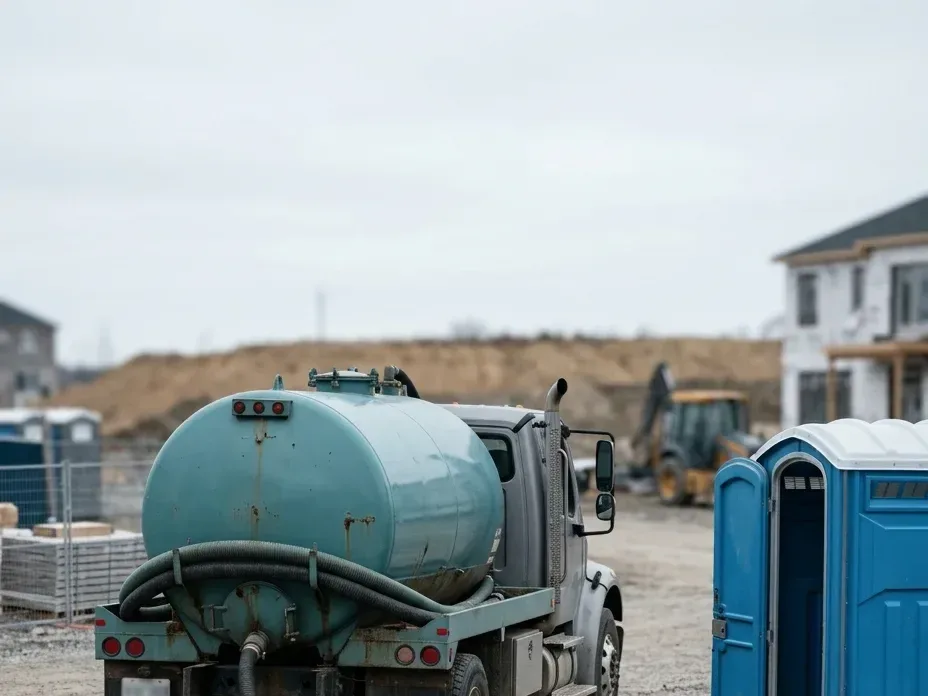
What a service truck actually is
A portable-restroom service truck is a purpose-built vacuum truck, not a cargo van with a tank thrown in the back. It carries:
- A waste tank that holds what you pump out of the units.
- A separate fresh-water tank for rinsing and refilling.
- A vacuum pump that does the pumping.
- Hoses, a wand, and the plumbing to keep waste and fresh water strictly separated.
That separation is the whole point. You pull waste out of a unit into the waste tank, then refill the unit with fresh water and deodorizer from the fresh-water tank — and the two never mix. A van cannot do this safely or legally, which is why the truck is a real, unavoidable cost.
What it costs
A new portable-restroom vacuum truck runs roughly $65,000–$150,000, with most professional builds landing at $80,000–$130,000 (per KeeVac 2025). Used and smaller trucks are cited at $45,000–$80,000 in startup guides (per jim.com 2026).
It is the single largest purchase in the business, which is why so many operators buy used or start without a dedicated truck at all. A well-maintained used truck with a sound tank and pump can run for years; the things to inspect are the tank integrity, the pump condition, and the vehicle’s own mechanical health, since a truck this heavy is expensive to keep on the road.
The slide-in vacuum unit: how to start without a truck
If a dedicated truck is out of reach, the slide-in is the startup path. A slide-in vacuum unit is a compact tank-and-pump unit — commonly 300–750 gallons — that drops into the bed of a full-size pickup you already own, marketed specifically to startups and tight urban routes (per KeeVac 2026). It gives you pumping capability without buying and insuring a dedicated vehicle.
Public pricing on slide-in units is thin, so treat a rough $10,000–$25,000 for the unit itself as a planning estimate and get a real quote for your capacity. The trade-off is capacity: a slide-in holds less than a dedicated truck, so you offload more often and your route radius is tighter. That is fine when you are proving your first accounts — you upgrade to a dedicated truck once the route can carry the payment.
Sizing the tank
Waste-tank capacity on portable-restroom trucks commonly ranges from about 750 to 1,800-plus gallons (per KeeVac 2025), split between the waste tank and a smaller fresh-water tank. Bigger tanks mean more units serviced between disposal trips — which matters most on dense routes far from your dump site, where a disposal run costs you real drive time.
Size the tank to your route, not to the biggest truck you can finance. If your dump site is close and your route is tight, a smaller tank offloads quickly and you barely notice. If you are servicing 40 units an hour from the nearest treatment plant, tank size directly sets how many stops you can hit before you lose an hour driving to dump. Think about your actual geography before you size up.
How many units can one truck service?
A single truck can typically service 15 to 60 units before it has to offload, depending on tank size and how full the units are (per Porta Potty Calculator 2025). Across a full week of routes, one technician can manage 100–120 units on the books (per jim.com 2026).
Those two numbers set the ceiling on a one-truck operation. When you are consistently bumping against them — units waiting on service, routes that no longer fit in a day — that is the signal to add a second truck, covered in scaling routes and adding a second truck. Your tank size and route density, not your ambition, set how many stops a day actually works.
The truck drives your insurance, too
One more reason the truck is the central decision: it drives your insurance cost. A vacuum truck is a heavy commercial vehicle hauling liquid waste, which insurers price as a higher-risk class than a normal work van — which is part of why some operators start with a slide-in on a lighter truck. Factor the commercial-auto premium into your truck decision from the start; the full picture is in insurance for a portable restroom business. Then price your rentals so the truck payment, fuel, and maintenance are all covered — the method is in pricing your rentals and service.
Frequently Asked Questions
- How much does a porta potty service truck cost?
- A new portable-restroom vacuum truck runs roughly $65,000–$150,000, with most professional builds landing at $80,000–$130,000 (per KeeVac 2025). Used and smaller trucks are cited at $45,000–$80,000 in startup guides (per jim.com 2026). It is the single largest purchase in the business, so many operators buy used or start with a slide-in unit and upgrade once the route can carry a truck payment.
- What is a slide-in vacuum unit, and is it cheaper?
- A slide-in is a compact tank-and-pump unit (commonly 300–750 gallons) that drops into the bed of a full-size pickup you already own, marketed specifically to startups and tight urban routes (per KeeVac 2026). It is the lowest-cost way to get pumping capability without a dedicated truck. Exact pricing is not publicly published, so treat a rough $10,000–$25,000 for the slide-in unit itself as a planning estimate and get a real quote.
- How big should the tank be?
- Waste-tank capacity on portable-restroom trucks commonly ranges from about 750 to 1,800-plus gallons (per KeeVac 2025), split between a waste tank and a smaller fresh-water tank. Bigger tanks mean more units serviced between disposal trips, which matters most on dense routes far from your dump site. Size the tank to your route, not to the biggest truck you can finance.
- How many units can one truck service before it fills up?
- A single truck can typically service 15 to 60 units before it has to offload, depending on tank size and how full the units are (per Porta Potty Calculator 2025). One technician can manage 100–120 units on the books across a week of routes (per jim.com 2026). Your tank size and route density, not your ambition, set how many stops a day actually works.
Run the route from your phone, and stamp every stop
SwapProof is built for solo and small-crew portable-restroom operators — track your fleet, drive the route offline in a dead-zone site, and stamp every service with a photo, GPS when you allow it, and a timestamp you can forward. The free tier tracks up to 10 units and two active placements — enough to prove the loop on your first accounts, no card.